Boat navigation light rules: red, green and white lights explained
What the Inland Navigation Rules require: which lights a powerboat, sailboat, rowboat or anchored boat shows, their colors and arcs, and how far they must be seen.
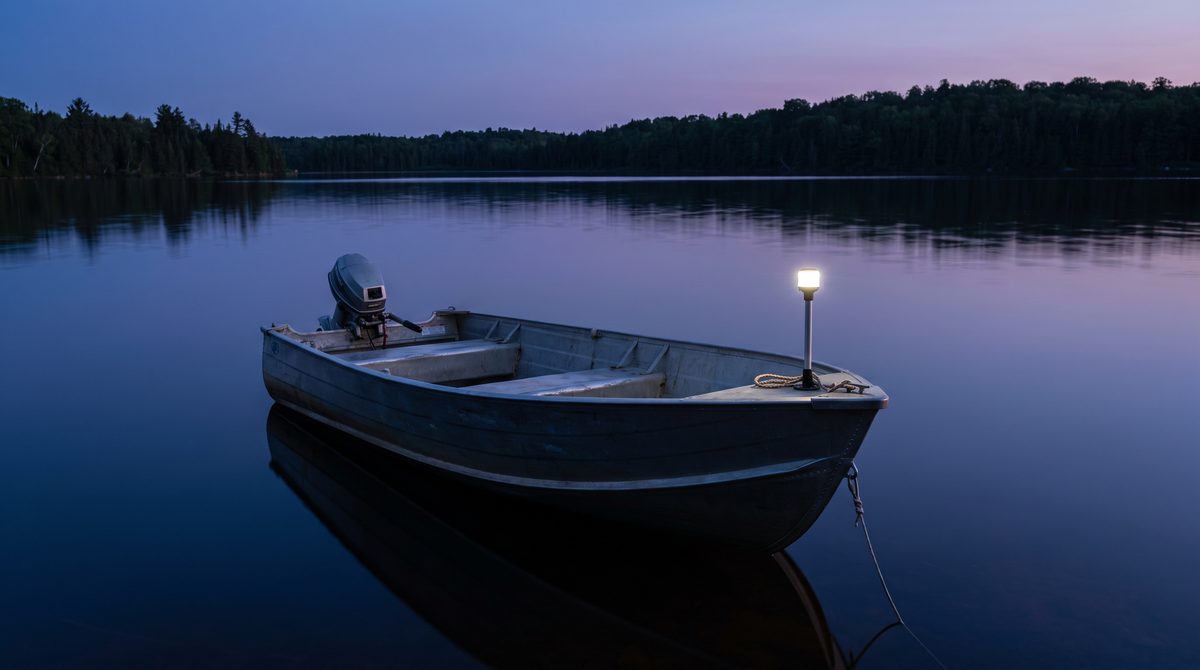
From sunset to sunrise, and by day in restricted visibility, a boat must show the navigation lights set by the Inland Navigation Rules (33 CFR part 83, Rules 20 to 31). A powerboat underway shows a red sidelight to port, a green sidelight to starboard, a white masthead light forward and a white sternlight; under 12 meters (39.4 feet) it may show sidelights and one all-round white light instead. Sailboats under sail drop the masthead light; rowboats, kayaks and small sailboats may get by with a white light ready at hand.
Where these rules apply
The Inland Rules apply to all vessels on the inland waters of the United States. The COLREGS demarcation lines of 33 CFR part 80 divide the two regimes: inside the lines are Inland Rules waters, outside are the waters of the International Regulations (72 COLREGS). A boat whose lights meet the International Regulations is considered to comply with the Inland Rules too. State law can require them too: Florida, for example, requires the lights and shapes of the navigation rules on every vessel on its waters.
When the lights must be on
- From sunset to sunrise, in all weathers. During that time no other light may be shown that could be mistaken for a navigation light, impair its visibility or interfere with keeping a proper lookout.
- From sunrise to sunset in restricted visibility — fog, mist, falling snow, heavy rainstorms and similar conditions — if the boat carries the lights.
- Lights and shapes may be lowered when needed to pass under a bridge.
The lights and their arcs
| Light | Color | Arc of visibility | Where it shows |
|---|---|---|---|
| Sidelights | Green on starboard (right), red on port (left) | 112.5° each | From right ahead to 22.5° abaft the beam on its own side |
| Masthead light | White | 225° | From right ahead to 22.5° abaft the beam on either side |
| Sternlight | White | 135° | 67.5° from right aft on each side |
| All-round light | White (or other colors where a rule says so) | 360° | All around the horizon |
The arcs fit together: the two sidelights cover 225° forward, the same as the masthead light, and the sternlight covers the remaining 135° aft. Seen from another boat, red and green together mean you are looking at the bow; red alone, the port side; green alone, the starboard side; a single white light, the stern of a boat underway or a boat at anchor or a small boat showing an all-round light. On a vessel under 20 meters the two sidelights may be combined in one lantern on the centerline.
What your boat shows underway
| Boat | Lights | Rule |
|---|---|---|
| Powerboat (any length) | Masthead light forward, sidelights, sternlight. A second masthead light is optional under 50 meters. | § 83.23(a) |
| Powerboat under 12 m (39.4 ft) | As an alternative: sidelights and one all-round white light | § 83.23(d) |
| Powerboat on the Great Lakes | An all-round white light may replace the second masthead light and the sternlight | § 83.23(e) |
| Sailboat under sail | Sidelights and sternlight (no masthead light). Under 20 m they may be combined in one tricolor lantern at the top of the mast. | § 83.25(a)-(b) |
| Sailboat under 7 m (23 ft) | The sailing lights if practicable; otherwise an all-round white light, or a white torch or lantern ready at hand and shown in time to prevent a collision | § 83.25(d)(i) |
| Rowboat, canoe, kayak | The sailing lights, or an all-round white light, or a white torch or lantern ready at hand | § 83.25(d)(ii) |
The rules count a sailboat as a sailing vessel only while its engine, if fitted, is not being used; with the engine running it is a power-driven vessel and shows the powerboat lights. By day, a boat motorsailing shows a cone, apex down, forward; under 12 meters the cone is optional.
How far the lights must be seen
| Light | Under 12 m | 12 m to under 20 m |
|---|---|---|
| Masthead light | 2 miles | 3 miles |
| Sidelights | 1 mile | 2 miles |
| Sternlight | 2 miles | 2 miles |
| All-round light | 2 miles | 2 miles |
The light intensities that give these ranges are set in Annex I (33 CFR part 84).
At anchor
- A vessel under 50 meters at anchor may show a single all-round white light where it can best be seen.
- Under 7 meters, no anchor light is needed when anchored away from narrow channels, fairways, anchorages and places where other vessels normally navigate.
- Under 20 meters, no anchor light is needed in a special anchorage area designated by the Coast Guard.
A copy of the rules
The operator of a self-propelled vessel 12 meters (39.4 feet) or more in length must carry a copy of the Inland Navigation Rules on board for ready reference. Under 12 meters it is not required.
Navigation lights are the one equipment item the equipment checklist lists only as a reminder: the right set depends on how the boat is used at the moment (under power, under sail, at anchor), so use the tables above. For sound signals see the checklist; for flares and distress lights see visual distress signals.
Frequently asked questions
Which side of a boat is the red light on?
The red sidelight is on the port side, the left looking forward; the green one is on the starboard side, the right. Each shows from straight ahead to 22.5 degrees behind the beam on its side, over an arc of 112.5 degrees.
Does a kayak or canoe need navigation lights?
A boat under oars or paddles may show the sailing lights, but the Inland Rules accept an all-round white light, or an electric torch or lighted lantern showing a white light kept ready at hand and shown in time to prevent a collision.
Sources
- 33 CFR § 83.01 — Application (Inland Rule 1), read on November 25, 2026
- 33 CFR § 80.01 — General basis and purpose of demarcation lines, read on November 25, 2026
- 33 CFR § 83.20 — Application (Inland Rule 20), read on November 25, 2026
- 33 CFR § 83.03 — General definitions (Inland Rule 3), read on November 25, 2026
- 33 CFR § 83.21 — Definitions (Inland Rule 21), read on November 25, 2026
- 33 CFR § 83.23 — Power-driven vessels underway (Inland Rule 23), read on November 25, 2026
- 33 CFR § 83.25 — Sailing vessels underway and vessels under oars (Inland Rule 25), read on November 25, 2026
- 33 CFR § 83.30 — Vessels anchored, aground and moored barges (Inland Rule 30), read on November 25, 2026
- 33 CFR § 83.22 — Visibility of lights (Inland Rule 22), read on November 25, 2026
- Florida Statutes § 327.50 — Vessel safety regulations; equipment and lighting requirements, read on November 25, 2026
Read next
- Federal rules
Life jacket laws for boats: federal rule and state ages
One per person, a throwable from 16 feet, and the age at which children must wear one: under 13 federally and in Texas, under 8 in Alabama.
- Federal rules
Boat fire extinguisher requirements by length and model year
The 33 CFR § 175.320 table by length, the outboard exception, model years 1953–2017, and why other guides disagree.
- Federal rules
Visual distress signal requirements: flares, flags and lights
Coastal waters, day and night signals from 16 feet, the combinations of flares, flags and lights that meet the rule.