Federal rules
Life jacket laws for boats: federal rule and state ages
One per person, a throwable from 16 feet, and the age at which children must wear one: under 13 federally and in Texas, under 8 in Alabama.
Prepared by GearAboard, a publication of Redbit S.r.l.s.
This text was generated with artificial intelligence tools and checked against the sources cited on this page. How we work
The U.S. Coast Guard equipment requirements for recreational boats are federal regulations, published in Title 33 of the Code of Federal Regulations. Part 175 sets what must be on board: life jackets, fire extinguishers, visual distress signals and ventilation. The Inland Navigation Rules in part 83 add the sound signal equipment. They apply to boats on waters subject to the jurisdiction of the United States and to boats owned in the United States on the high seas.
This section has one guide for each item that most often causes doubts, with the text of the rule, the thresholds that change the answer and the points where other guides go wrong. To get the list for your own boat, use the equipment checklist.
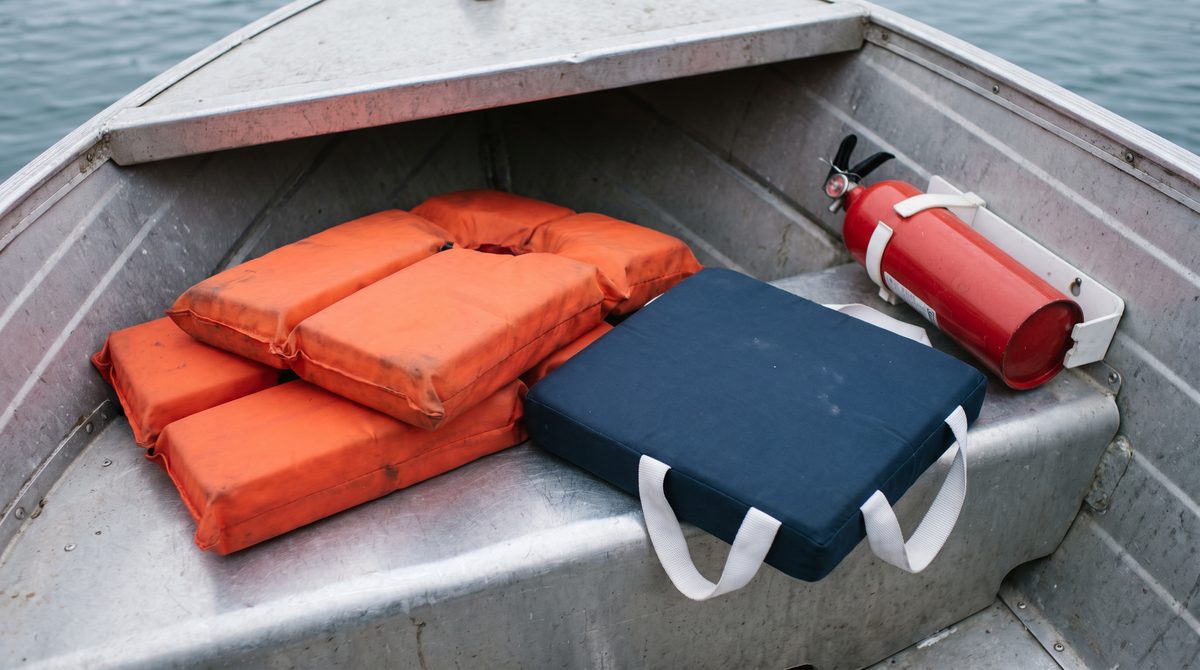
One per person, a throwable from 16 feet, and the age at which children must wear one: under 13 federally and in Texas, under 8 in Alabama.
The 33 CFR § 175.320 table by length, the outboard exception, model years 1953–2017, and why other guides disagree.
Coastal waters, day and night signals from 16 feet, the combinations of flares, flags and lights that meet the rule.
| Item | Who must carry it | Rule |
|---|---|---|
| Wearable life jackets | Every recreational vessel: one per person on board | 33 CFR § 175.15(a) |
| Throwable device | Boats 16 feet or more (not canoes and kayaks) | 33 CFR § 175.15(b), § 175.17 |
| Fire extinguishers | Boats propelled or controlled by machinery, by length | 33 CFR § 175.320 |
| Visual distress signals | Boats on coastal waters; under 16 feet only at night | 33 CFR § 175.110 |
| Ventilation | Gasoline-engine boats built after July 31, 1980 | 33 CFR § 175.201 |
| Sound signals | Every vessel: a whistle from 12 meters (39.4 feet), a bell too from 20 meters | 33 CFR § 83.33 |
No one may use a recreational vessel unless at least one wearable personal flotation device (PFD) is on board for each person, used as its approval label and owner’s manual require. Each one must be readily accessible, in serviceable condition, of the right size and fit for the person who will wear it and legibly marked with its approval number. From 16 feet, one throwable device is added and must be immediately available. Children under 13 must wear one while the boat is under way, unless they are below decks or in an enclosed cabin; where a state has set its own age, the state rule applies instead. Details and exemptions: life jacket requirements.
The fire extinguisher rules apply to recreational vessels propelled or controlled by propulsion machinery, so a sailboat with no engine or a canoe is outside them. Up to 65 feet the minimum number of 5-B portable extinguishers depends on length: one under 26 feet, two from 26 to under 40, three from 40 to 65, one fewer with a fixed system in the machinery space. A boat under 26 feet with an outboard motor can be exempt when its construction cannot trap fuel vapors. These rules moved from 46 CFR part 25 to 33 CFR part 175 on April 20, 2022. Details, model years and the condition each extinguisher must be in: fire extinguisher requirements.
On coastal waters and on the high seas, a boat 16 feet or more must carry signals suitable for day use and for night use; a boat under 16 feet, a manually propelled boat or an open sailboat under 26 feet without an engine needs night signals between sunset and sunrise. Coastal waters include the Great Lakes, the territorial seas and the connected waters wider than 2 nautical miles at the entrance. Details: visual distress signal requirements.
A boat built after July 31, 1980 that has a gasoline engine, for propulsion, mechanical power or a generator, must have an operable ventilation system that meets 33 CFR 183.610 and 183.620(a). For sound, a vessel of 12 meters (39.4 feet) or more must have a whistle, and from 20 meters a bell as well; a smaller vessel need not carry those, but must have some other means of making an efficient sound signal.
States enforce the federal requirements on their waters and add their own: registration, operator education or licensing, engine cut-off switches, rules for towing skiers, life jackets in certain areas. Where a state sets an age for children to wear a life jacket, it replaces the federal age. See boating laws by state.
All sources and what we take from each: Sources.
Yes for most of them. Life jackets, fire extinguishers, ventilation and sound signals apply on all waters subject to U.S. jurisdiction. Visual distress signals are the exception: the federal rule covers coastal waters, the Great Lakes and connected waters more than 2 nautical miles wide, not small inland lakes.
No. The federal fire extinguisher rules apply to recreational vessels propelled or controlled by propulsion machinery. A sailboat with an auxiliary engine is covered; one moved only by sail is not. Some states go further: Alabama requires an extinguisher on any vessel with a fuel-burning stove or lantern.
We would like to use Google Analytics to count visits and see which pages help readers. It sets cookies and only runs if you accept. The site works the same either way, it shows no ads and we do not sell or share your data. Your choice lasts 6 months. Cookie policy · Privacy policy
Your browser sends a Global Privacy Control signal: we treat it as “Reject”.