Life jacket laws for boats: federal rule and state ages
One wearable life jacket per person on every recreational boat, a throwable device from 16 feet, and a child age for wearing one that your state can change.
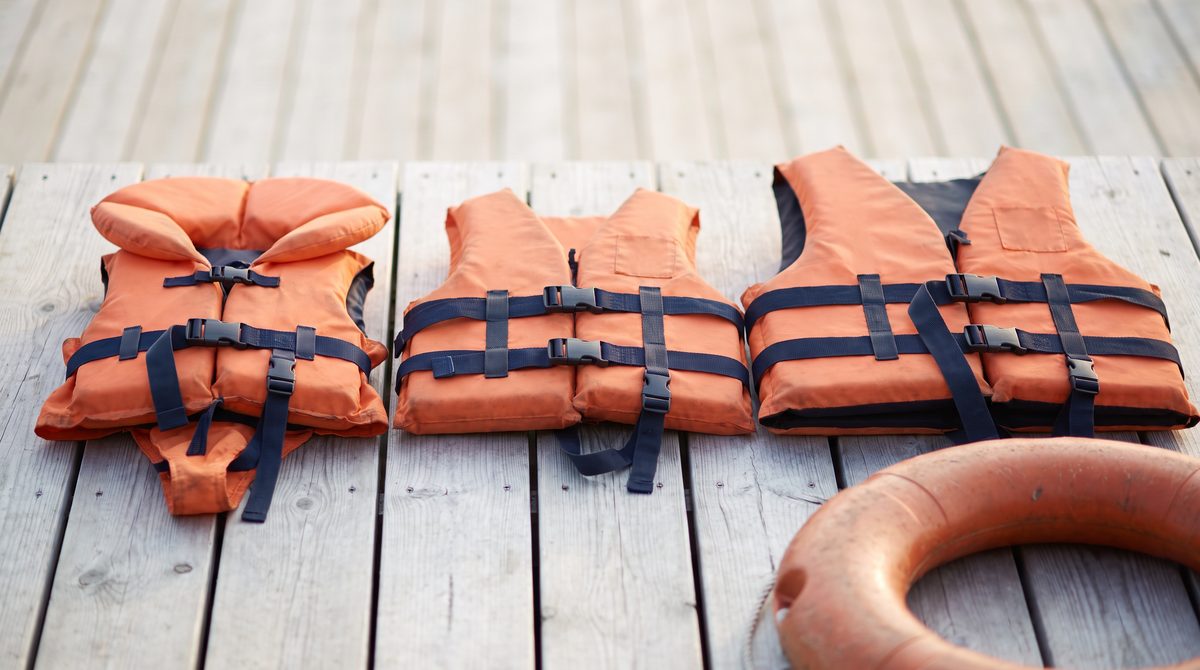
The federal life jacket rule fits in three sentences. Every recreational vessel must carry at least one wearable personal flotation device (PFD) for each person on board. A vessel 16 feet or more in length must also carry one throwable PFD. A child under 13 must wear an approved PFD while the boat is under way, unless below decks or in an enclosed cabin — and where your state has set a different age, the state’s age applies instead.
One wearable life jacket per person
Under 33 CFR § 175.15(a), no one may use a recreational vessel unless at least one wearable PFD is on board for each person. The rule counts people, not seats: a boat with five people aboard needs five wearable PFDs, whatever its capacity plate says. Each PFD must be used in accordance with its approval label, and with its owner’s manual when the label refers to one.
Carrying them is not enough. Section 175.19 requires every wearable PFD to be readily accessible, and section 175.21 requires each one to be in serviceable condition, of an appropriate size and fit for the person who will wear it, as marked on the approval label, and legibly marked with its approval number. A life jacket sealed in its plastic bag at the bottom of a locker, or an adult jacket for a small child, does not meet the rule.
Labels: Types and Performance Levels
Older approved jackets are labelled Type I, II, III or V; newer ones carry a “Performance Level” of 50, 70, 100 or 150. The Alabama Marine Patrol checklist states that both are accepted as long as the device is approved and in good and serviceable condition. Inflatable life jackets count only when used as their approval label says: Alabama notes they are authorized for people 16 and older and are not serviceable unless the cylinder is full and the status indicators are green, and Texas does not approve them at all on personal watercraft.
The throwable device from 16 feet
Section 175.15(b) adds one throwable PFD on boats of 16 feet or more, on top of the wearable ones. It must be immediately available (§ 175.19), meaning within reach to throw, not stowed. Canoes and kayaks of 16 feet or more are exempt from this extra device (§ 175.17(a)).
Children: the federal age and the state age
Section 175.15(c) forbids operating a recreational vessel under way with a child under 13 aboard unless the child is wearing an appropriate Coast Guard approved PFD or is below decks or in an enclosed cabin. Section 175.25 then says that where a state has established by statute an age for children to wear a PFD, that requirement applies on the state’s waters instead of the federal one. In practice the age depends on where you are:
| Where | Rule | Source |
|---|---|---|
| Federal rule | Under 13, while under way, unless below decks or in an enclosed cabin | 33 CFR § 175.15(c) |
| Texas | Under 13, Type I, II or III, while the vessel is underway (not at anchor, made fast to shore or aground) | Texas Parks and Wildlife |
| Alabama | Under 8, at all times on any vessel, fastened, except inside an enclosed cabin or sleeping space | Alabama Law Enforcement Agency |
Who is exempt
Section 175.17 exempts racing shells, rowing sculls, racing canoes and racing kayaks, and sailboards, from carrying any PFD under § 175.15. It also exempts canoes and kayaks of 16 feet or more from the throwable device only: they still need one wearable PFD per person. An ordinary recreational kayak or canoe is not a racing craft.
When a life jacket must be worn, not just carried
Federally, carrying is the rule for adults. States add situations where wearing it is mandatory. On a personal watercraft, Texas requires every occupant and anyone towed to wear one, and Alabama requires it of everyone operating, riding on or towed by a PWC. Alabama also requires everyone aboard to wear a PFD within 800 feet below a hydroelectric dam or a navigational lock and dam, and requires people towed on skis or tubes to wear one approved for the activity.
A quick check before you leave the dock
- Count the people aboard and the wearable PFDs: one each, sized for each person.
- Check that every label is legible and shows the approval number; look for tears, rot or damage.
- On an inflatable, check the cylinder and the status indicator.
- At 16 feet or more, put the throwable device where you can grab and throw it.
- Put the children’s jackets on before casting off, at the age your state sets.
Frequently asked questions
How many life jackets do I need on my boat?
One wearable, Coast Guard approved life jacket for each person on board, of the right size for that person and readily accessible. If the boat is 16 feet or longer, add one throwable device kept immediately available; canoes and kayaks of that length are exempt from the throwable.
Do adults have to wear a life jacket on a boat?
Under federal law adults must have one on board, not wear it. States require wearing it in specific cases: on a personal watercraft in Texas and Alabama, and in Alabama within 800 feet below a dam or lock and when being towed on skis or tubes.
Is an inflatable life jacket legal?
Yes, when it is Coast Guard approved and used as its label says. Alabama notes inflatables are authorized for people 16 and older and must have a full cylinder and green indicators; Texas does not approve inflatables on personal watercraft.
Sources
- 33 CFR § 175.15 — Personal flotation devices required, read on November 25, 2026
- 33 CFR § 175.19 — Stowage, read on November 25, 2026
- 33 CFR § 175.21 — Condition; size and fit; approval marking, read on November 25, 2026
- ALEA — Boat equipment checklist for Alabama, read on November 25, 2026
- TPWD — Powerboats less than 16 feet: required safety equipment, read on November 25, 2026
- TPWD — Personal watercraft: required safety equipment, read on November 25, 2026
- 33 CFR § 175.17 — Exemptions, read on November 25, 2026
- 33 CFR § 175.25 — Enforcement of State requirements for children to wear PFDs, read on November 25, 2026
- ALEA — Boating rules and regulations, read on November 25, 2026
Read next
- Federal rules
Boat fire extinguisher requirements by length and model year
The 33 CFR § 175.320 table by length, the outboard exception, model years 1953–2017, and why other guides disagree.
- Federal rules
Visual distress signal requirements: flares, flags and lights
Coastal waters, day and night signals from 16 feet, the combinations of flares, flags and lights that meet the rule.