Boat fire extinguisher requirements by length and model year
One 5-B extinguisher under 26 feet, two from 26 to under 40, three from 40 to 65, one fewer with a fixed system; older boats may keep older units in good condition.
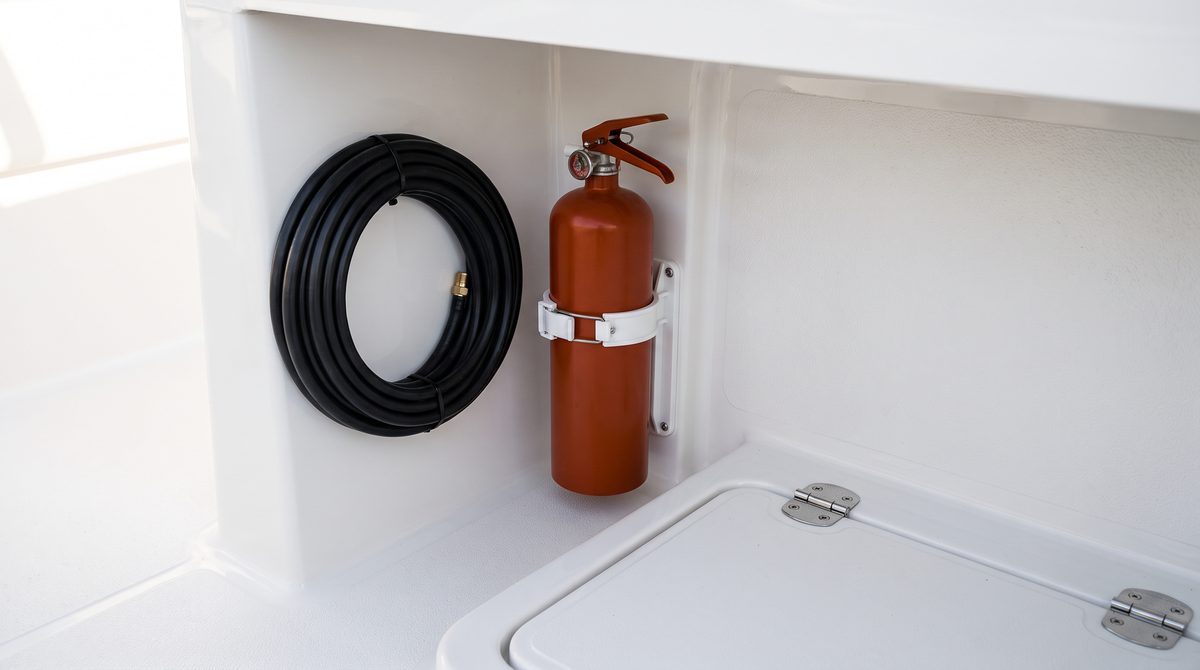
A recreational boat with an engine must carry at least one 5-B portable fire extinguisher under 26 feet, two from 26 to under 40 feet and three from 40 to 65 feet, with one fewer when a fixed extinguishing system protects the machinery space. One 20-B extinguisher can replace two 5-B units. An outboard boat under 26 feet is exempt when its construction cannot trap fuel vapors. The rule is 33 CFR § 175.320, in force for recreational boats since April 20, 2022.
The table, by length
| Length | No fixed system in machinery space | Fixed system in machinery space |
|---|---|---|
| Under 16 feet | 1 | 0 |
| 16 to under 26 feet | 1 | 0 |
| 26 to under 40 feet | 2 | 1 |
| 40 to 65 feet | 3 | 2 |
One 20-B portable extinguisher may be substituted for two 5-B extinguishers, and extinguishers with larger numerical ratings or multiple letter designations may be used to meet the table. Over 65 feet the minimum depends on gross tonnage and is counted in 20-B units (table 4 of § 175.320), plus extinguishers for the main engines’ horsepower.
Which boats the rule covers
Subpart E of part 175 applies to recreational vessels propelled or controlled by propulsion machinery. A sailboat with an auxiliary engine, a pontoon with an outboard, a personal watercraft and a bass boat are all covered. A sailboat moved only by sail, a canoe or a kayak is not.
The outboard exception, and what defeats it
A vessel less than 26 feet in length, propelled by an outboard motor, does not need a portable extinguisher if its construction will not permit the entrapment of explosive or flammable gases or vapors. The regulation lists the conditions that do require extinguishers:
- a closed compartment under thwarts and seats where portable fuel tanks may be stored;
- double bottoms not sealed to the hull or not completely filled with flotation material;
- closed living spaces;
- closed stowage compartments in which combustible or flammable materials are stowed;
- permanently installed fuel tanks.
And it lists conditions that do not, by themselves, require one: bait wells, glove compartments, buoyant flotation material, open slatted flooring and ice chests. Texas Parks and Wildlife adds inboard engines to the list of conditions that require an extinguisher.
Model year: can I keep my old extinguisher?
The 2022 rules answer this directly. A model year runs from June 1 of one year to July 31 of the next and is named for the year in which it ends (§ 175.3). Boats constructed before August 22, 2016 are deemed built before model year 2017.
- Model years 1953 to 2017 (§ 175.380): extinguishers already installed with a lower capacity than the table requires need not be replaced, but must be kept in good condition. Every extinguisher installed after August 22, 2016 must meet the current rules.
- Model year 2018 and newer: the extinguishers must meet §§ 175.305–175.320, the 5-B and 20-B ratings above.
- Before model year 1953 (§ 175.390): previously approved equipment may stay in service in good condition; new installations and replacements must meet the current rules.
What “good and serviceable” means
Section 175.310 requires every portable extinguisher to be on board and readily accessible, of an approved type, not expired and not appearing to have been used, and in good working condition: if it has a pressure gauge or indicator, the reading must be in the operable range; the lock pin must be firmly in place; the discharge nozzle must be clean and free of obstruction; and the extinguisher must not show visible signs of significant corrosion or damage. Extinguishers containing carbon tetrachloride or other toxic vaporizing liquids are not acceptable.
Why guides disagree: 46 CFR, B-I and 5-B
Three things explain most contradictions you will find online.
The rule moved. Until 2022, the table for motorboats sat in 46 CFR § 25.30-20, in the subchapter for uninspected vessels. The Coast Guard’s final rule “Fire Protection for Recreational Vessels” (86 FR 58571), effective April 20, 2022, relocated the recreational requirements to 33 CFR part 175 and relieved owners of inspection, maintenance and recordkeeping requirements suited to commercial vessels. The 46 CFR table is still in force for uninspected commercial vessels, so guides that quote it are not quoting a dead rule — just the wrong one for a pleasure boat.
The rating names changed. The current tables count 5-B and 20-B extinguishers. Older labels used B-I and B-II. Texas Parks and Wildlife’s equipment pages still use the older sizes — one B-1 under 26 feet, two B-1 or one B-2 from 26 to under 40 feet, three B-1 or one B-2 plus one B-1 from 40 to 65 feet — while the Alabama Marine Patrol checklist uses 5-B and states that boats under 26 feet from model years 1953–2017 may keep B-I and B-II units while serviceable.
Age limits. The federal rule says an extinguisher must not be expired. The Alabama Marine Patrol checklist adds that if there is a date stamped on the bottle, the extinguisher must not be more than 12 years old according to that date.
State rules on top
Alabama requires an approved extinguisher on any vessel with a stove, lantern or other device burning butane, propane, kerosene, gasoline or another petroleum product, outboard motors excepted. For the full list in Texas and Alabama see the Texas and Alabama pages, or run the equipment checklist with your state.
Frequently asked questions
Do I need a fire extinguisher on a jet ski?
Yes. A personal watercraft is a recreational vessel propelled by machinery and under 16 feet, so the federal table requires one 5-B portable extinguisher. Texas and Alabama both list an extinguisher among the required equipment for personal watercraft.
Are B-I fire extinguishers still legal on a boat?
On boats from model years 1953 to 2017, extinguishers already installed with a lower rating need not be replaced if kept in good condition. Any extinguisher installed after August 22, 2016, and those on model year 2018 and newer boats, must meet the current 5-B and 20-B ratings.
How old can a boat fire extinguisher be?
The federal rule says it must not be expired and must show no sign of previous use, with the gauge in range. The Alabama Marine Patrol checklist adds that an extinguisher with a date stamped on the bottle must not be more than 12 years old.
Sources
- 33 CFR § 175.320 — Fire extinguishing equipment required, table 1, read on November 25, 2026
- 33 CFR § 175.301 — Applicability, read on November 25, 2026
- TPWD — Fire extinguisher requirements and types, read on November 25, 2026
- 33 CFR § 175.3 — Definitions, read on November 25, 2026
- 33 CFR § 175.380 — Model year 2017 or earlier, read on November 25, 2026
- 33 CFR § 175.390 — Built before model year 1953, read on November 25, 2026
- 33 CFR § 175.310 — Portable fire extinguishers, read on November 25, 2026
- 46 CFR § 25.30-20 — Fire extinguishing equipment required, read on November 25, 2026
- Fire Protection for Recreational Vessels, final rule, 86 FR 58571 (October 22, 2021), read on November 25, 2026
- TPWD — Powerboats 16 to less than 26 feet: required safety equipment, read on November 25, 2026
- TPWD — Powerboats 26 to less than 40 feet: required safety equipment, read on November 25, 2026
- TPWD — Powerboats 40 to less than 65 feet: required safety equipment, read on November 25, 2026
- ALEA — Boat equipment checklist for Alabama, read on November 25, 2026
- TPWD — Personal watercraft: required safety equipment, read on November 25, 2026
Read next
- Federal rules
Life jacket laws for boats: federal rule and state ages
One per person, a throwable from 16 feet, and the age at which children must wear one: under 13 federally and in Texas, under 8 in Alabama.
- Federal rules
Visual distress signal requirements: flares, flags and lights
Coastal waters, day and night signals from 16 feet, the combinations of flares, flags and lights that meet the rule.