Visual distress signal requirements: flares, flags and lights
Required on coastal waters only: day and night signals from 16 feet, night signals under 16 feet between sunset and sunrise.
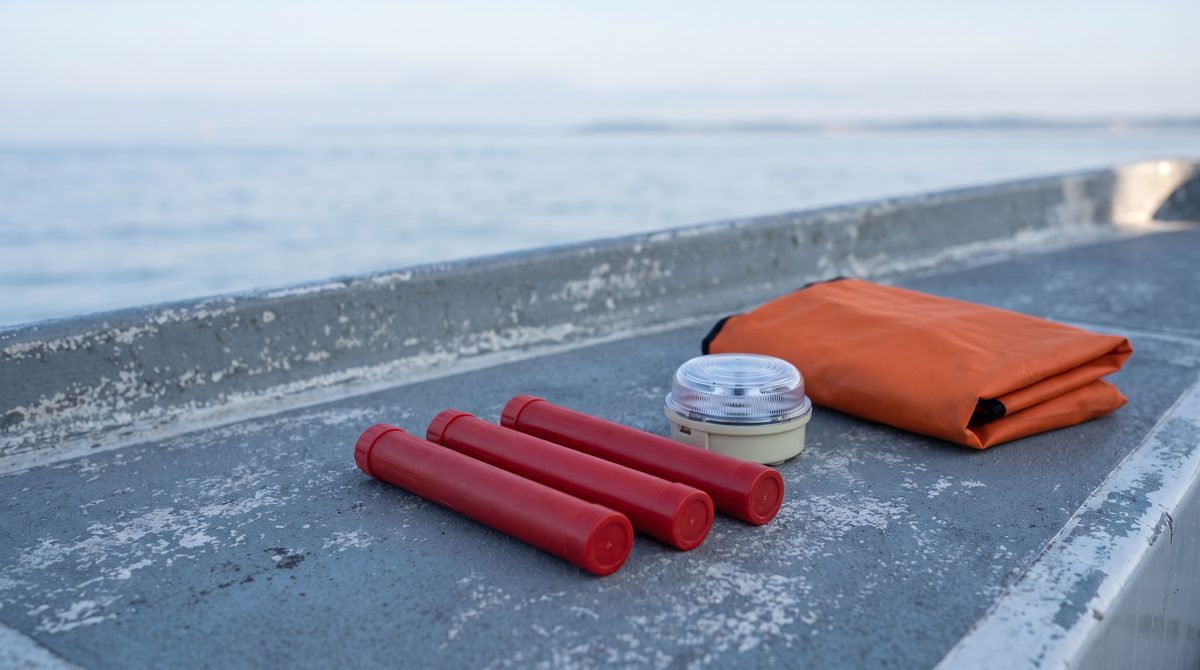
On coastal waters — the Great Lakes, the territorial seas and the waters connected to them where the entrance is more than 2 nautical miles wide — a boat 16 feet or more must carry visual distress signals for day and night use. A boat under 16 feet needs night signals only when used between sunset and sunrise. On inland waters that are not coastal waters, the federal rule does not apply.
Where the rule applies
Subpart C of 33 CFR part 175 applies to boats on the coastal waters of the United States and, for boats owned in the United States, on the high seas beyond the territorial seas (§ 175.101). Section 175.105 defines coastal waters as:
- the U.S. waters of the Great Lakes (Erie, Huron, Michigan, Ontario and Superior);
- the territorial seas of the United States;
- the waters directly connected to the Great Lakes and territorial seas — bays, sounds, harbors, rivers, inlets — where any entrance exceeds 2 nautical miles between opposite shorelines, up to the first point where the largest distance between shorelines narrows to 2 miles.
So a bay with a wide mouth counts, and so does the lower part of a large river, up to where it narrows to 2 nautical miles. A reservoir or a lake inland does not. The National Ocean Service chart for the area is the reference the regulation names for measuring.
Who must carry what
| Boat | Requirement |
|---|---|
| 16 feet or more | Day and night signals, at all times |
| Under 16 feet | Night signals between sunset and sunrise |
| Manually propelled boat | Night signals between sunset and sunrise |
| Open sailboat under 26 feet with no engine | Night signals between sunset and sunrise |
| Boat in an organized parade, regatta or race | Night signals between sunset and sunrise |
Which signals count
Section 175.130 accepts three kinds of devices, alone or combined:
- an electric distress light meeting 46 CFR 161.013: one meets the night-only requirement;
- an orange distress flag meeting 46 CFR 160.072: one meets the day-only requirement;
- pyrotechnic signals (hand-held red flares, parachute flares, orange smoke, aerial flares) of the approved types listed in Table 175.130, in the number the table sets. Table 175.130 also sets a manufacture date of October 1, 1980 or later.
The regulation gives two examples of combinations that meet both day and night requirements: two hand-held red flares plus one parachute red flare; or three hand-held orange smoke signals plus one electric distress light. An orange flag for the day plus an electric light for the night also covers both, without pyrotechnics.
State pages say the same thing differently
Texas Parks and Wildlife lists day and night signals for boats 16 feet and over “if operating in coastal waters of the state”, and night signals for smaller boats between sunset and sunrise, and asks that signals be readily accessible, in working condition and unexpired if dated. The Alabama Marine Patrol checklist describes the same federal rule and recommends storing pyrotechnics in a cool, dry place in a watertight container marked “Distress signals”.
Before you head out
- Decide whether today’s trip reaches coastal waters: a wide bay or the Gulf, yes; an inland lake, no.
- At 16 feet or more, make sure you have both day and night signals; under 16 feet, a night signal if you could still be out after sunset.
- Check expiry dates on flares and the batteries of an electric light.
Frequently asked questions
Do I need flares on an inland lake?
Not under federal law. The visual distress signal rule applies on coastal waters: the Great Lakes, the territorial seas and connected waters where the entrance is more than 2 nautical miles wide. A state can have its own rule, so check your state agency.
Can I use an electric light instead of flares?
Yes for night use: one electric distress light meeting 46 CFR 161.013 meets the night requirement. For day use you need an orange distress flag or approved day pyrotechnics, so a flag plus a light covers both without flares.
Sources
- 33 CFR § 175.101 — Applicability, read on November 25, 2026
- 33 CFR § 175.105 — Definitions, read on November 25, 2026
- 33 CFR § 175.110 — Visual distress signals required, read on November 25, 2026
- 33 CFR § 175.115 — Exceptions, read on November 25, 2026
- 33 CFR § 175.130 — Visual distress signals accepted, read on November 25, 2026
- TPWD — Powerboats 16 to less than 26 feet: required safety equipment, read on November 25, 2026
- ALEA — Boat equipment checklist for Alabama, read on November 25, 2026
Read next
- Federal rules
Life jacket laws for boats: federal rule and state ages
One per person, a throwable from 16 feet, and the age at which children must wear one: under 13 federally and in Texas, under 8 in Alabama.
- Federal rules
Boat fire extinguisher requirements by length and model year
The 33 CFR § 175.320 table by length, the outboard exception, model years 1953–2017, and why other guides disagree.